
Building an indoor snow park involves much more than purchasing a snowmaking machine. The final investment depends on the refrigerated area, ceiling height, indoor temperature, snow depth, attraction mix, expected visitor capacity, local climate, building condition, power price, and the level of theming required.
A compact snow room inside a shopping mall may require only a few hundred square meters, several simple snow activities, and a moderate refrigeration system. A destination-scale indoor snow park may include tubing lanes, snow slides, ski-training areas, rental facilities, restaurants, changing rooms, mechanical rooms, and several independent snowmaking systems.
Because the technical systems are closely connected, investors should develop the concept, thermal envelope, refrigeration plant, snow production system, attractions, and operating plan together. The indoor snow park design process should begin before equipment selection so that machinery is sized around the actual building and commercial model.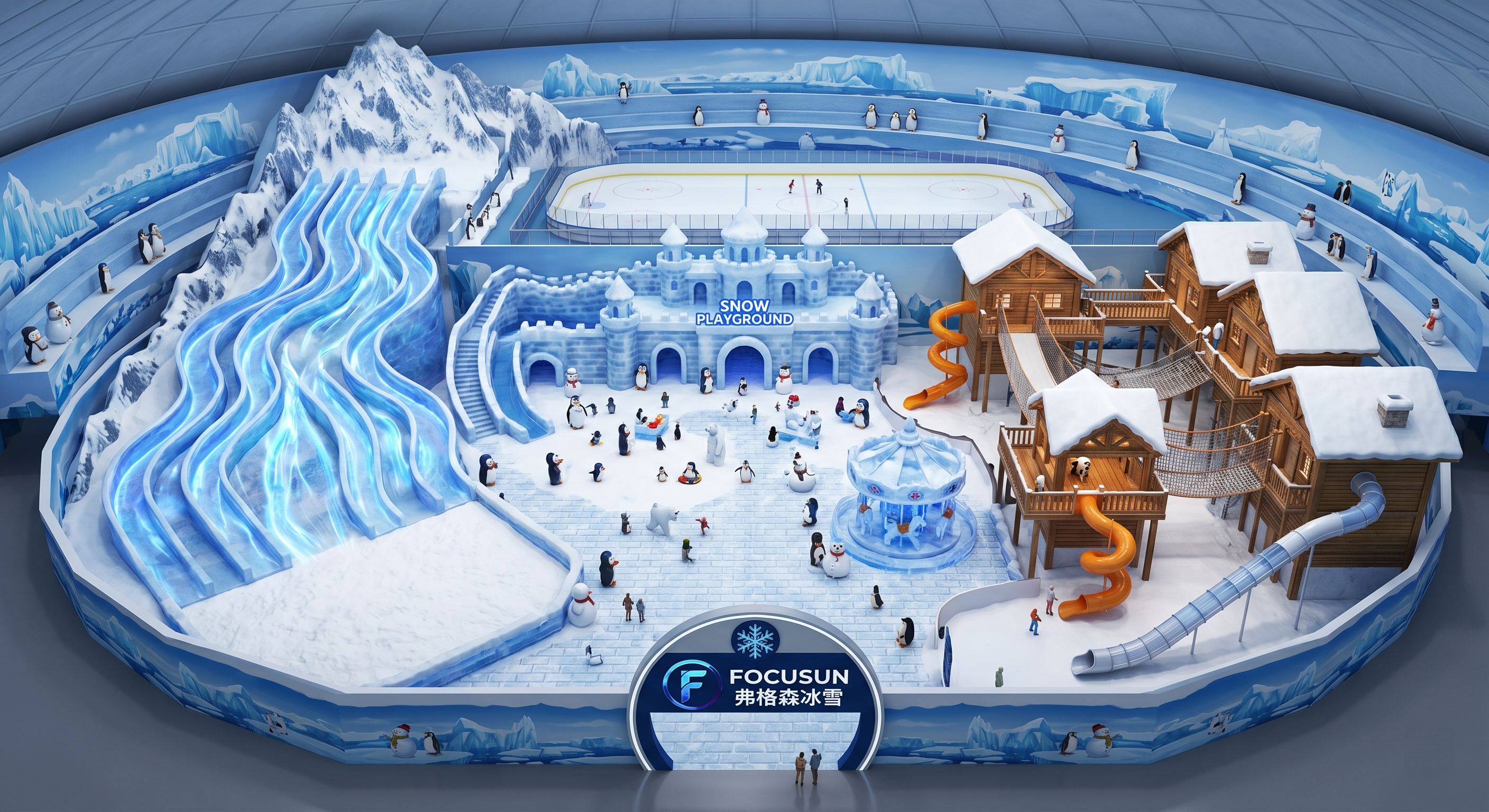
For preliminary feasibility planning, indoor snow park projects can be divided into four broad investment levels.
|
Project Type |
Typical Refrigerated Area |
Main Applications |
Preliminary Investment Range |
|
Compact snow experience room |
100–300 m² |
Hotels, malls, photo attractions, children’s snow play |
USD 250,000–1 million |
|
Family indoor snow park |
500–1,500 m² |
Snow slides, snow play, small tubing lanes, themed scenes |
USD 1–6 million |
|
Regional snow entertainment center |
2,000–5,000 m² |
Multiple attractions, larger tubing areas, events, food and retail |
USD 5–20 million |
|
Large indoor ski or snow destination |
8,000 m² and above |
Ski slopes, large tubing runs, training zones, resort-scale operation |
USD 20–80 million or more |
These figures are early planning ranges rather than quotations. They may exclude land, financing, major external building construction, import duties, local taxes, permit fees, utility upgrades, and working capital.
Two parks with the same floor area can have very different costs. A five-meter-high family snow room operating near −5°C is fundamentally different from a twenty-meter-high indoor ski slope requiring deeper snow, lifts, stronger structures, higher airflow, and greater refrigeration capacity.
Design normally covers:
Professional design may represent approximately 3%–8% of the complete project budget. More complex projects can require separate architectural, structural, refrigeration, MEP, fire-safety, ride-safety, and themed-entertainment consultants.
Cutting design costs too aggressively can create expensive changes during construction. Refrigeration pipes, drainage channels, electrical cables, air ducts, ride foundations, insulation panels, and maintenance routes must all fit within the same building.
An existing warehouse or shopping mall space is not automatically ready for a snow park. The structure may require reinforcement for snow loads, elevated platforms, slides, machinery, or suspended decorations.
Building-related costs may include:
An existing building with sufficient power, drainage, ceiling height, and loading access can reduce investment. A site requiring major structural modification may cost more than a purpose-built shell.
The snow park must function as a controlled refrigerated envelope. Insulated wall and ceiling panels reduce heat transfer, while vapor barriers prevent warm, humid air from entering the structure.
The insulation package commonly includes:
Insulation is frequently underestimated because investors compare only panel prices. Installation quality, joint sealing, vapor control, floor construction, and thermal bridges can be more important than the nominal panel thickness.
Poor insulation increases compressor runtime, snow melt, condensation, icing around doors, and long-term electricity consumption. A complete thermal and moisture-control strategy is therefore one of the most important investments in a year-round snow attraction.
Refrigeration is usually one of the largest equipment costs. It controls room temperature, snow quality, humidity, surface conditions, and the stability of the entire attraction.
A complete system may include:
Refrigeration equipment may represent approximately 20%–35% of the project investment, depending on the climate and attraction type.
The system cannot be selected by floor area alone. Engineers must evaluate ceiling height, outdoor conditions, building heat gain, visitor load, lighting, door openings, operating hours, snowmaking heat load, equipment heat, infiltration, and target temperature.
A project in a hot, humid region generally needs more refrigeration and moisture control than the same park in a cool, dry region.
The term “snow machine” can refer to several different systems. The correct equipment depends on whether the park needs atmospheric snowfall, playable snow, tubing snow, ski-slope coverage, or rapid snow replenishment.
Snow falling machines create a visible snowfall effect. They are commonly installed above photo zones, themed streets, event stages, hotel displays, and visitor entrances.
They are selected according to:
They improve atmosphere but may not provide enough accumulated snow for a large play zone or ski slope.
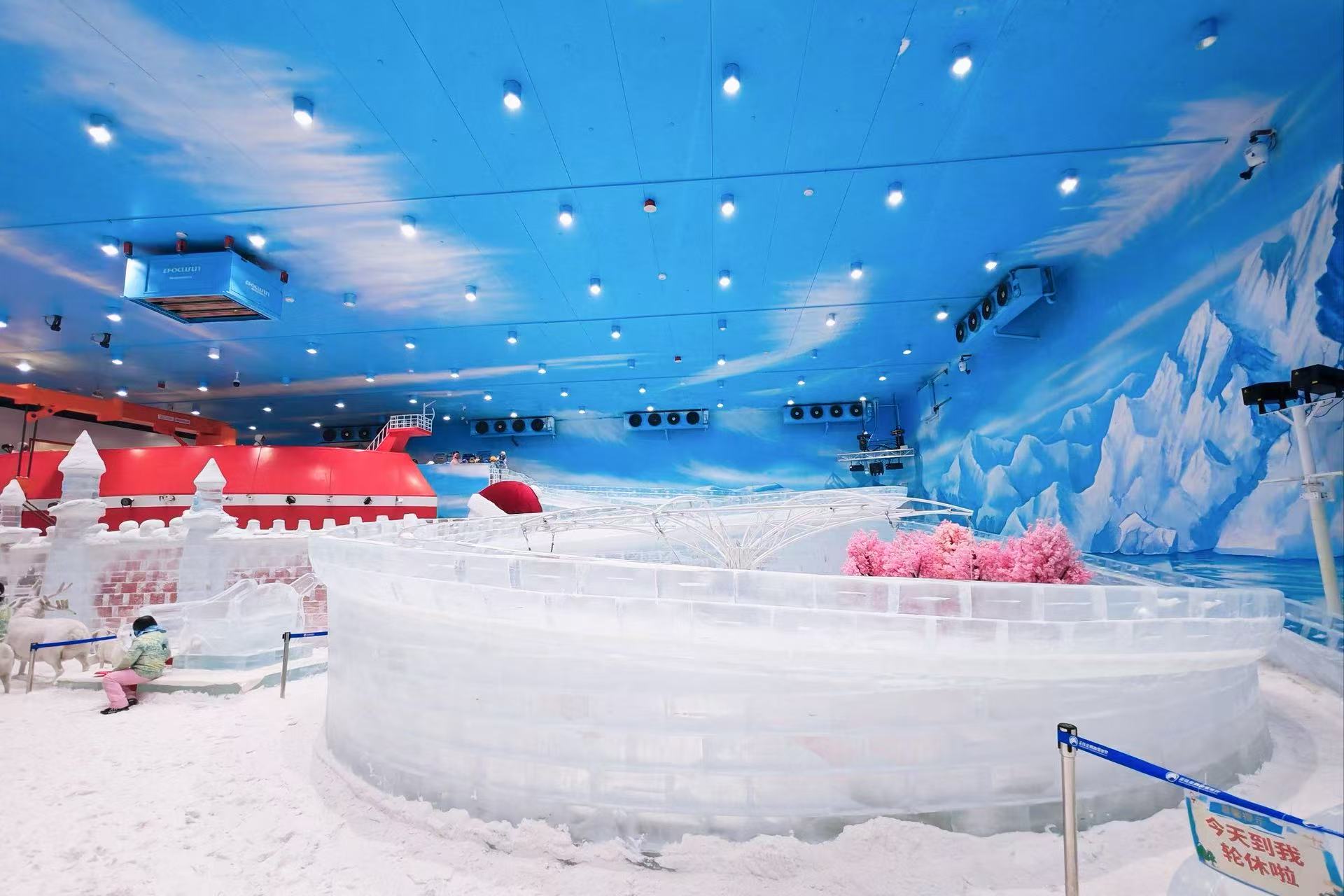
Snow spray machines produce and distribute snow across a defined area. They can be used for small slopes, play areas, events, and localized snow coverage.
They are generally more flexible than fixed snowfall systems, but the required output must be matched to daily snow loss and visitor activity.
High-temperature or all-weather snow systems use integrated refrigeration to produce snow independently of normal winter weather. They are suitable for warm climates, year-round attractions, outdoor summer events, and projects where natural cold-air snowmaking is unreliable.
Containerized snow factories can reduce some on-site assembly work by integrating major components into prefabricated modules. The high-temperature snowmaking technology guide explains how these systems differ from conventional outdoor snow guns.
Investors comparing technologies should also review how all-weather snowmaking systems are matched to decorative snowfall, local snow coverage, and large-volume production.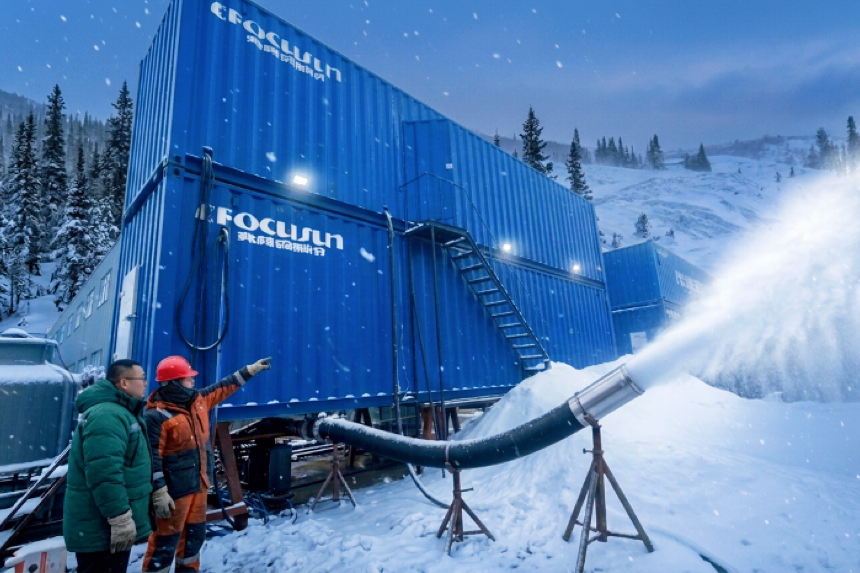
Making snow is only the first part of the process. The park must also move, distribute, store, maintain, and eventually remove snow.
Supporting equipment may include:
Large parks may require snow to be produced in a separate mechanical area and transported to the attraction zone. This increases piping, conveyor, structural, and control costs.
Attractions can account for 10%–30% of the project investment. The percentage depends on whether the park is a simple snow-play room or a fully themed entertainment destination.
Common attractions include:
Many attractions does not automatically create a better park. Fast activities must be separated from slow family play, and supervisors must have clear sightlines. Maintenance routes and snow-grooming access must remain open.
Visitors entering a refrigerated environment may need jackets, boots, gloves, helmets, or snow-sport equipment.
The supporting area may include:
These spaces do not produce snow, but they strongly affect visitor capacity and operating efficiency. A park designed for 500 visitors per hour needs a much larger rental and changing operation than a small attraction receiving 50 visitors per hour.
Snow parks require substantial utility planning. The site may need:
Utility upgrades can become a major hidden expense. Before signing a lease or purchasing a building, investors should confirm the available electrical capacity, voltage, frequency, water pressure, drainage capacity, and equipment access.
Imported refrigeration and snowmaking equipment may create additional costs for:
A low factory equipment price does not represent the complete installed cost. Buyers should request clear delivery boundaries, such as EXW, FOB, CIF, or delivered-to-site pricing.
For an initial feasibility study, the project budget may be distributed approximately as follows:
|
Cost Category |
Typical Share of Total Project Budget |
|
Design, engineering, and project management |
3%–8% |
|
Building preparation and structural work |
10%–25% |
|
Insulation and moisture-control envelope |
10%–18% |
|
Refrigeration system |
20%–35% |
|
Snowmaking, distribution, and grooming |
8%–20% |
|
Attractions, theming, lighting, and audio |
10%–30% |
|
Electrical, water, drainage, and controls |
8%–15% |
|
Installation, shipping, and commissioning |
8%–15% |
|
Contingency |
10%–15% |
The percentages are not intended to add up as a fixed template. Some items overlap, and the allocation changes according to project scope.
For example, a simple industrial-style snow training room may spend heavily on refrigeration but little on theming. A highly immersive mall attraction may invest more in decoration, lighting, photo points, and guest services.
A practical starting method is to calculate the usable activity area from visitor capacity.
Required activity area = Peak simultaneous visitors × Area allowance per visitor
Typical preliminary allowances may be:
The activity area is not the complete building area. Additional space is required for:
A family park with 300 simultaneous visitors and an allowance of 6 m² per visitor would require approximately:
300 × 6 m² = 1,800 m² of activity area
If activity space represents 60% of the total facility, the complete project may need approximately:
1,800 ÷ 0.60 = 3,000 m² of total floor area
This is an initial planning calculation only. The final layout must also consider attraction footprints, landing zones, supervision, ceiling height, and local safety regulations.
How to Estimate Daily Snow Demand
Daily snow production should cover initial snow filling, normal melting, snow removed through entrances, compaction, grooming losses, and seasonal replenishment.
A simple planning formula is:
Daily snow requirement = Existing snow volume × Daily replacement rate
Suppose a 1,000 m² play area has an average snow depth of 0.20 m:
1,000 m² × 0.20 m = 200 m³ of snow
If the park replaces approximately 5% of the snow volume per day:
200 m³ × 5% = 10 m³ of replacement snow per day
A higher replacement rate may be required when the park has:
Snow density also matters. One cubic meter of loose artificial snow does not weigh the same as one cubic meter of compacted slope snow. Equipment suppliers therefore need both the required snow volume and the intended application.
A cheaper construction package may create higher electricity and maintenance costs for many years. Investors should compare total ownership cost rather than equipment price alone.
The main operating expenses include:
Electricity is normally one of the largest technical operating expenses. Consumption depends on refrigeration load, room temperature, operating hours, insulation, outdoor climate, snow production, lighting, visitor traffic, and equipment efficiency.
A preliminary monthly electricity estimate can be calculated as:
Monthly electricity cost = Average operating power × Operating hours per day × Operating days × Electricity tariff
For example, if the combined average load is 350 kW, the park operates 14 hours per day for 30 days, and electricity costs USD 0.12 per kWh:
350 × 14 × 30 × 0.12 = USD 17,640 per month
The installed electrical capacity may be significantly higher than the average running load because compressors, pumps, snow equipment, dryers, lighting, and other systems do not always operate at full power simultaneously.
A professional energy model should include day and night operation, peak visitor hours, defrost cycles, snow-production schedules, and seasonal ambient conditions.
Mall projects often benefit from existing visitor traffic, parking, food service, and public utilities. However, they may face strict limits on floor loading, machinery noise, equipment access, ceiling height, and electrical capacity.
The attraction usually focuses on family play, short slides, themed scenes, photography, and visible snowfall.
Hot and humid climates increase heat infiltration and moisture-control requirements. Entrance design becomes especially important.
Such projects may need:
Year-round systems reduce dependence on local weather, but equipment selection must be based on actual ambient temperature, humidity, and operating conditions.
Ski and tubing projects are generally more expensive because they require long slopes, greater ceiling height, deeper snow, structural platforms, lifts or conveyors, safety barriers, and larger refrigeration systems.
The building shell and structure may represent a larger share of the investment than the snow machines themselves.
Temporary attractions may use modular insulation, containerized snow systems, removable theming, and portable snow-distribution equipment.
They can reduce permanent construction costs but may create additional expenses for transport, assembly, dismantling, storage, and repeated commissioning.
Floor area is useful for comparison, but it does not account for ceiling height, indoor temperature, visitor load, snow depth, local climate, or attraction type.
Refrigerated volume is often more useful than floor area:
A 1,000 m² room with a five-meter ceiling contains 5,000 m³ of refrigerated space. The same floor area with a fifteen-meter ceiling contains 15,000 m³.
Snow equipment should be selected after confirming the room dimensions, target snow type, production schedule, distribution route, and daily replacement requirement.
Purchasing machinery too early can result in insufficient output, excessive capacity, unsuitable snow texture, or difficult installation.
Warm, humid air entering the park adds a significant refrigeration load. It may also cause fog, condensation, slippery floors, ice around entrances, and wet snow.
Door management, transition rooms, vapor barriers, dehumidification, and controlled airflow must be included in the cost plan.
Investors sometimes maximize the cold activity zone while reducing rental counters, lockers, workshops, staff areas, and storage.
This creates queues, slow clothing turnover, equipment congestion, and difficult maintenance after opening.
Lower-cost machinery may use more electricity, require more labor, create inconsistent snow, or lack local service support.
When comparing suppliers, evaluate:
The comparison of snow equipment for ski resorts and theme parks provides additional context on output, snow effects, cooling efficiency, and supporting systems.
Construction projects frequently encounter design changes, freight fluctuations, utility upgrades, permit requirements, or installation delays.
A contingency allowance of approximately 10%–15% should be considered during early budgeting. Investors should also reserve working capital for staff training, pre-opening marketing, initial spare parts, clothing inventory, and the first months of operation.
Prepare the following information before contacting an indoor snow park supplier:
Providing complete project information allows suppliers to calculate the refrigeration load, snowmaking capacity, insulation requirements, electrical demand, equipment layout, and installed project cost more accurately.
How much does it cost to build a small indoor snow park?
A compact indoor snow attraction of approximately 100–300 m² may require an initial investment of roughly USD 250,000–1 million. The cost depends on the existing building condition, refrigeration load, insulation, snowmaking output, attraction quality, utility upgrades, and installation country. A simple snow-play room will cost less than a heavily themed attraction with slides, rental clothing, and automated snowfall.
What is the most expensive part of an indoor snow park?
The refrigeration system is often one of the largest individual cost categories, particularly in hot and humid climates. Building preparation, insulation, snowmaking, themed attractions, and electrical infrastructure can also represent substantial investments. In large indoor ski projects, the building structure and slope construction may exceed the cost of the snowmaking equipment.
Can an existing warehouse be converted into a snow park?
Yes, but the warehouse must be assessed for structural capacity, ceiling height, insulation installation, floor waterproofing, drainage, electrical supply, equipment access, fire safety, and emergency exits. Conversion can be economical when the shell is suitable. If major structural and utility upgrades are required, a new purpose-designed building may be more practical.
How much snowmaking capacity does an indoor park need?
Capacity depends on the initial snow volume, daily melt rate, snow removed by visitors, grooming losses, operating schedule, and attraction type. The supplier should calculate both the initial filling requirement and the daily replacement requirement. A small playroom may need limited daily replenishment, while a busy tubing or ski area may require continuous production.
How long does it take to build an indoor snow park?
A compact snow room may require several months from design to opening. A medium family snow park may require approximately 8–18 months, while a large indoor ski destination can take two years or longer. The schedule depends on design approval, permits, building construction, equipment manufacturing, shipping, installation, testing, staff training, and commissioning.
How can indoor snow park operating costs be reduced?
The most effective measures include accurate refrigeration sizing, high-performance insulation, vapor-barrier control, efficient compressors, variable-speed motors, entrance buffers, humidity management, scheduled snow production, LED lighting, remote monitoring, and preventive maintenance. Energy savings should be considered during design because retrofitting insulation or refrigeration after opening is much more expensive.
What should be included in a turnkey indoor snow park quotation?
A detailed quotation should define design services, insulation, refrigeration, snowmaking machinery, snow distribution, control systems, attractions, electrical requirements, water requirements, drainage, shipping, installation, commissioning, training, spare parts, warranty, exclusions, and local responsibilities. It should also state the design conditions used for capacity and power calculations.
