
Choosing an industrial ice machine is a little like planning a long backcountry route: the equipment only makes sense after you understand the terrain, the distance, the weather, the load, and the weak points where things can go wrong.
For seafood processors, food factories, concrete cooling teams, logistics operators, and commercial ice suppliers, ice is not a side product. It is part of the operating system. If the ice comes late, melts too fast, is hard to handle, or does not match the product, the whole route gets harder.
That is why working with an experienced industrial refrigeration equipment manufacturer matters. You are not just buying a machine body, compressor, evaporator, and control cabinet. You are choosing a cooling strategy that has to survive peak season, hot weather, labor shortages, transport delays, hygiene requirements, and long daily runtime.
Focusun’s ice machine range covers block ice machines, tube ice machines, flake ice machines, plate ice machines, slurry ice machines, cube ice machines, and supporting ice handling equipment. That variety is useful because different ice types solve different field problems. The real buying question is not “Which ice machine is best?” The better question is: “Which ice format protects my product, fits my site, and lowers my total operating risk?”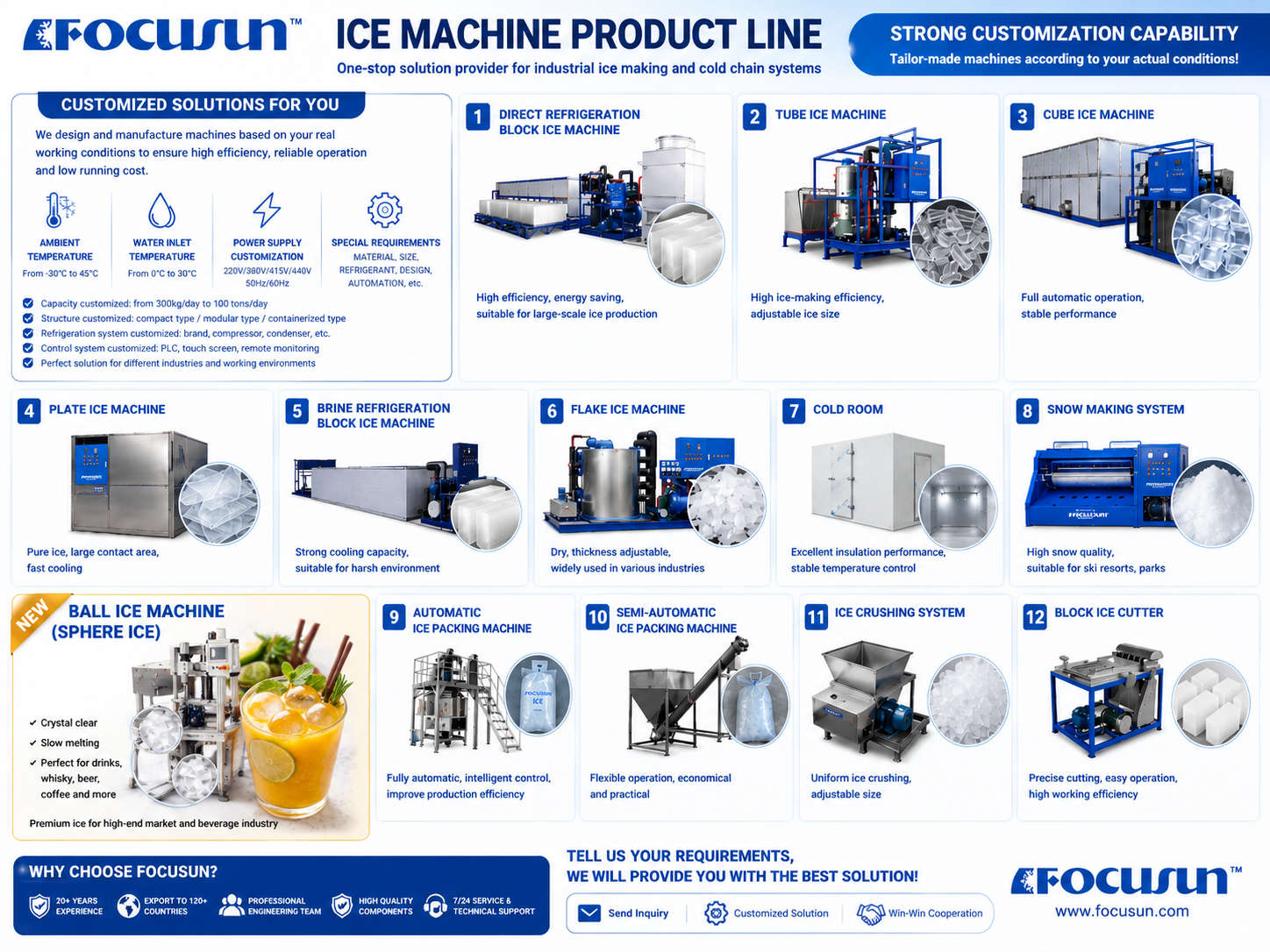
A small commercial ice maker can often be selected by daily capacity and footprint. Industrial refrigeration equipment needs more disciplined thinking. Capacity matters, but so do cooling speed, melting rate, ice hardness, sanitation level, storage method, installation environment, maintenance access, and how workers actually use the ice during a busy shift.
If you are still comparing ice formats, Focusun’s guide to common types of industrial ice machine is a useful starting point because it frames block ice, tube ice, cube ice, plate ice, and slurry ice by application rather than by catalog category.
Before you request a quote, build a simple operating map:
Fish, shrimp, meat, poultry, vegetables, bakery goods, beverages, and concrete do not respond to cooling in the same way. Delicate seafood needs fast, gentle surface contact. Concrete cooling needs controlled temperature reduction. Beverage ice needs clarity, hygiene, and shape consistency. A cold-chain operator may value slow melting more than fast pull-down.
A two-hour processing window and a four-day transport route are completely different problems. Fast-melting ice may be useful on a processing table, while dense block ice is better when the job is long-distance preservation.
If workers must cut, move, crush, bag, or load ice manually, the “cheapest” machine can become expensive in daily labor. Automation, conveyors, hoppers, crushers, and packing equipment may matter as much as the ice maker itself.
Ambient temperature, ventilation, water quality, drainage, power supply, corrosion exposure, and service space all affect performance. A machine that works well in a clean inland factory may need different material protection on a fishing port or vessel.
Block ice is the steady pack mule of industrial cooling. It is dense, durable, easy to store, and slow to melt. That makes it valuable for seafood transport, dockside supply, remote storage, concrete cooling, and any operation where the ice has to keep working over a long period.
If your route includes waiting time, rough handling, hot weather, or limited refill points, block ice deserves a serious look. For seafood operators, the practical advantage is clear: block ice gives a long cooling buffer. It can be stored, transported, crushed when needed, or loaded as whole blocks for extended preservation.
Focusun’s article on block ice machine for seafood transport is especially relevant for buyers who think in routes rather than factory diagrams. It explains why transport time, ambient heat, product type, packing method, and ice refill points should shape the equipment decision.
Choose block ice when you need long melting time, stacked storage, simpler logistics, and cooling insurance for uncertain routes. It is especially useful for fishing ports, seafood logistics companies, ice-selling plants, and remote cold-chain operations where operators cannot rely on frequent ice resupply.
Block ice is not always ready-to-use at the point of contact. Many users need ice crushers, cutters, conveyors, or manual handling equipment. That should be included in the layout from the beginning. A good industrial refrigeration equipment manufacturer should help you plan not only the ice-making section, but also how ice moves after production.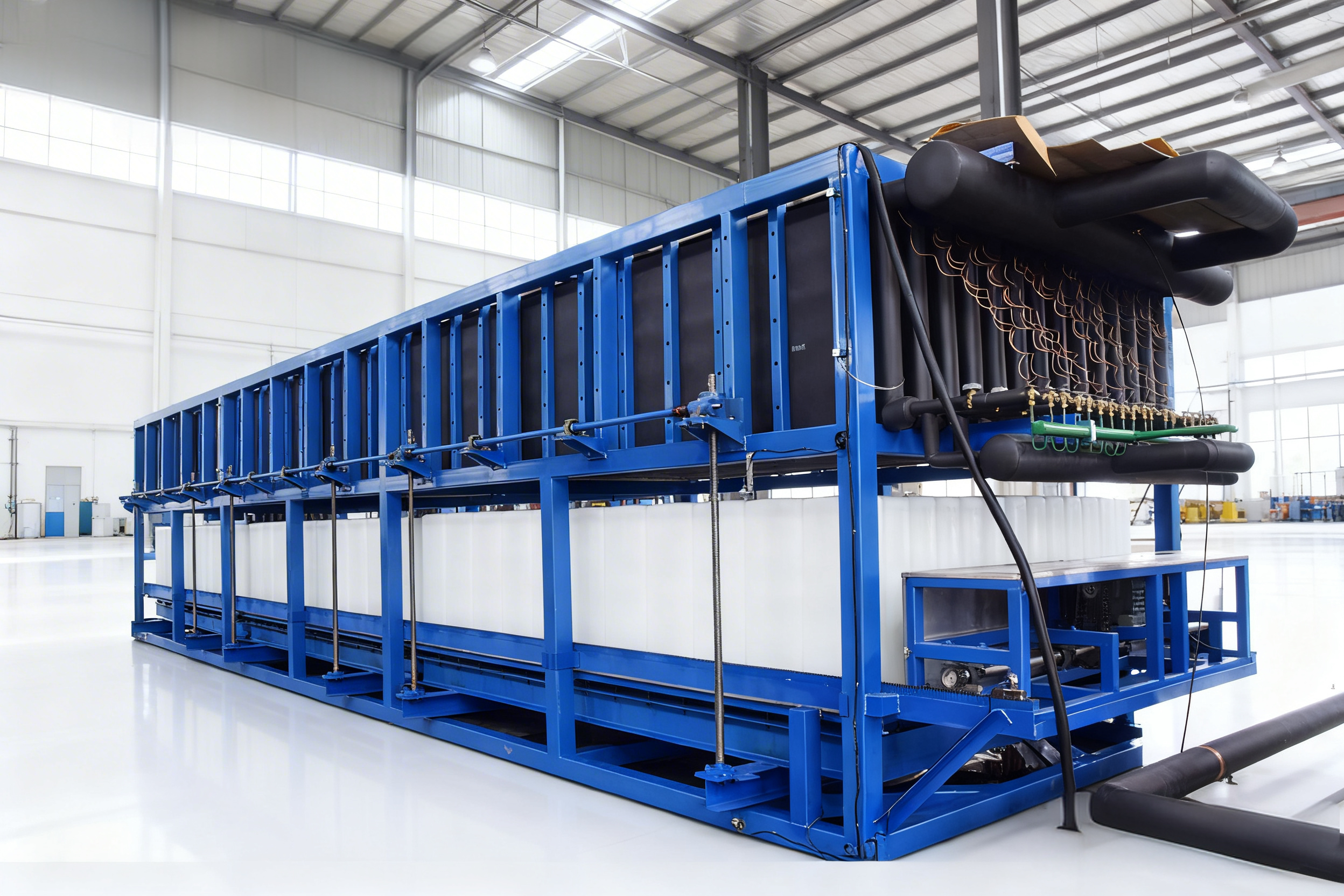
Flake ice is the quick-cover tool in the kit. It spreads easily, wraps around irregular product shapes, and creates large surface contact. That makes it useful for seafood processing, fish markets, poultry processing, vegetable cooling, bakery mixing, and concrete cooling.
If your priority is immediate contact cooling, flake ice often beats block ice. It does not need crushing before use, and workers can shovel, distribute, or blend it quickly. For production lines where product moves continuously, that handling advantage can reduce friction during peak hours.
Focusun’s guide on choosing an industrial flake ice machine for large-scale food processing and seafood cooling is useful when your main concerns are hygiene, corrosion resistance, cooling efficiency, and steady 24-hour operation.
Flake ice works well when product surface coverage matters more than long storage life. It is practical for fish displays, onboard catch cooling, meat and poultry processing, produce cooling, and ingredient temperature control.
Flake ice melts faster than dense block ice. If the job is long transport under hot conditions, it may need insulated storage, more frequent replenishment, or a combined strategy using block ice for reserve cooling and flake ice for direct contact.
For buyers comparing these two paths, Focusun’s article Block Ice Machine vs. Flake Ice Machine gives a more focused comparison between slow-melting storage ice and fast-contact cooling ice.
Tube ice sits between industrial utility and commercial presentation. It is hard, clean, easy to store, and convenient for bagging or distribution. For seafood, shellfish, chilled logistics, beverage service, and packaged ice sales, tube ice can be a flexible choice.
Unlike flake ice, tube ice has a firmer shape and better handling behavior. Unlike block ice, it normally does not need crushing before use. That makes it practical where the same ice may move through storage bins, packing machines, delivery trucks, and customer containers.
For fishery buyers, Focusun’s tube ice machine for fishery applications is worth reading because it looks at tube ice from an application angle, not just a machine-spec angle.
Tube ice is a good option when you need balance: reasonable melting resistance, clean appearance, easy packaging, and efficient handling. It is often considered by ice plants, seafood distributors, hotels, food processors, and beverage-related businesses.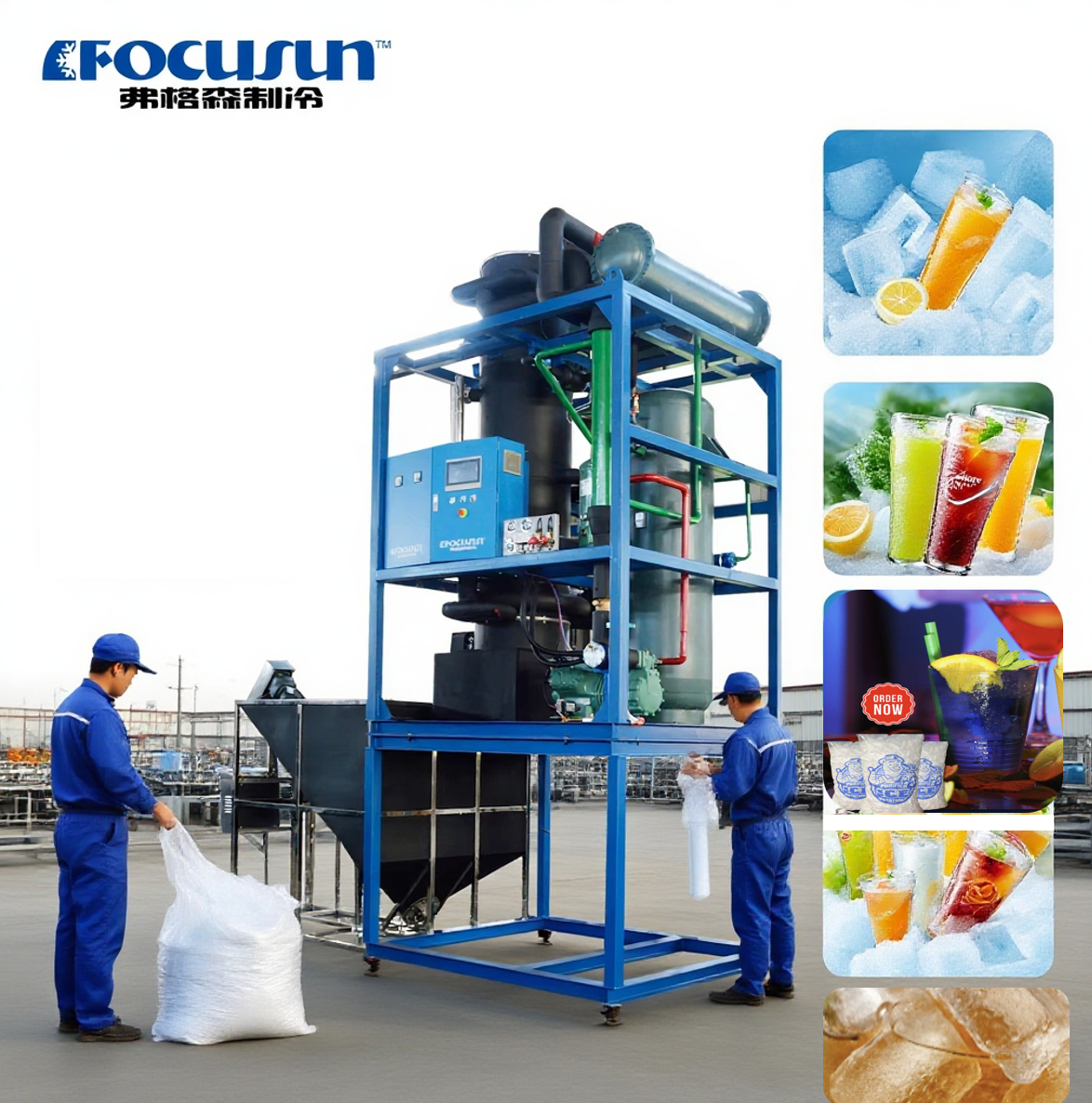
Slurry ice is built for speed and contact. Because it flows around the product, it can cool delicate seafood quickly and evenly. This is useful for onboard fish handling, aquaculture, seafood processing, and automated cooling systems where pumps and tanks are part of the process.
Slurry ice is not the simplest system to install. It needs planning around tanks, pumps, piping, salinity, controls, and cleaning. But when the goal is rapid pull-down with gentle product contact, it can be one of the most effective industrial cooling choices.
Plate ice is often used in industrial applications where broken ice pieces are needed for large-volume cooling. It can be relevant for concrete cooling, chemical processes, food processing, and industrial temperature control.
Cube ice is more familiar in beverage and hospitality environments, but large-capacity cube ice machines can also support packaged ice businesses, supermarkets, and distribution channels where ice appearance and portion consistency matter.
The key is not to force every job into one ice type. A well-matched industrial refrigeration system often combines ice production, storage, handling, and sometimes multiple ice formats.
If you are choosing a block ice machine, one of the biggest early decisions is direct cooling versus brine system.
Direct cooling block ice machines freeze water through aluminum plates or direct heat exchange surfaces. They are often cleaner, more compact, and easier to manage for food-grade operations. They can reduce labor and avoid some of the handling issues associated with traditional brine tanks.
Brine system block ice machines use chilled brine around molds to freeze water into dense blocks. This approach is widely used for large-capacity, heavy-duty block ice production. It can be attractive for seafood logistics, port supply, and ice plants that need rugged equipment and large blocks.
Focusun’s Brine vs. Direct Cooling guide is a useful read before choosing a block ice system because the wrong route can affect hygiene, labor, layout, production rhythm, and long-term maintenance.
Direct cooling is often suitable when hygiene requirements are higher, labor cost is a major concern, space is limited, and the buyer wants a cleaner, more automated operating process.
Brine systems are often suitable when the priority is large block production, rugged industrial use, long melting time, and lower-cost high-capacity production for seafood transport or ice sales.
For cold-chain logistics and seafood routes, Focusun’s article on brine system block ice machines for seafood and logistics adds more practical detail about slow-melting ice, transport planning, and marine operating conditions.
Many buyers spend weeks choosing ice type but only five minutes thinking about condenser cooling. That is a mistake.
The cooling method affects installation, performance stability, power use, water use, maintenance, noise, and output in hot weather. A machine installed in a hot, tight, poorly ventilated room may underperform if the condenser is not matched to the environment.
Focusun’s Air Cooling vs Water Cooling Ice Machine guide is a strong pre-purchase checkpoint because it connects the decision to real site conditions: ambient temperature, ventilation, utility costs, maintenance capacity, and plumbing.
Air-cooled machines are usually easier to install and do not consume extra cooling water. They work well in sites with good ventilation and manageable ambient temperature. They do, however, need proper clearance and clean condenser airflow.
Water-cooled machines can perform more consistently in hot or enclosed spaces, but they require more water, drainage, and plumbing planning. In areas with high water costs or strict discharge rules, operating cost should be reviewed carefully.
Daily ice capacity is one of the first numbers buyers ask for, but average demand can be misleading. A seafood plant may run normally most of the year and then hit extreme demand during harvest season. A concrete cooling project may need high output during hot-weather pouring. An ice plant may need reserve production before holidays or regional events.
A practical capacity plan should include:
Calculate the ice required for routine production, transport, storage, and cleaning-related cooling needs.
Identify your busiest weeks, hottest months, and highest-volume customer days. The machine should not be sized only for comfortable days.
Ice storage is your safety margin. If production and use happen at different times, the storage room or ice bin may be just as important as the machine capacity.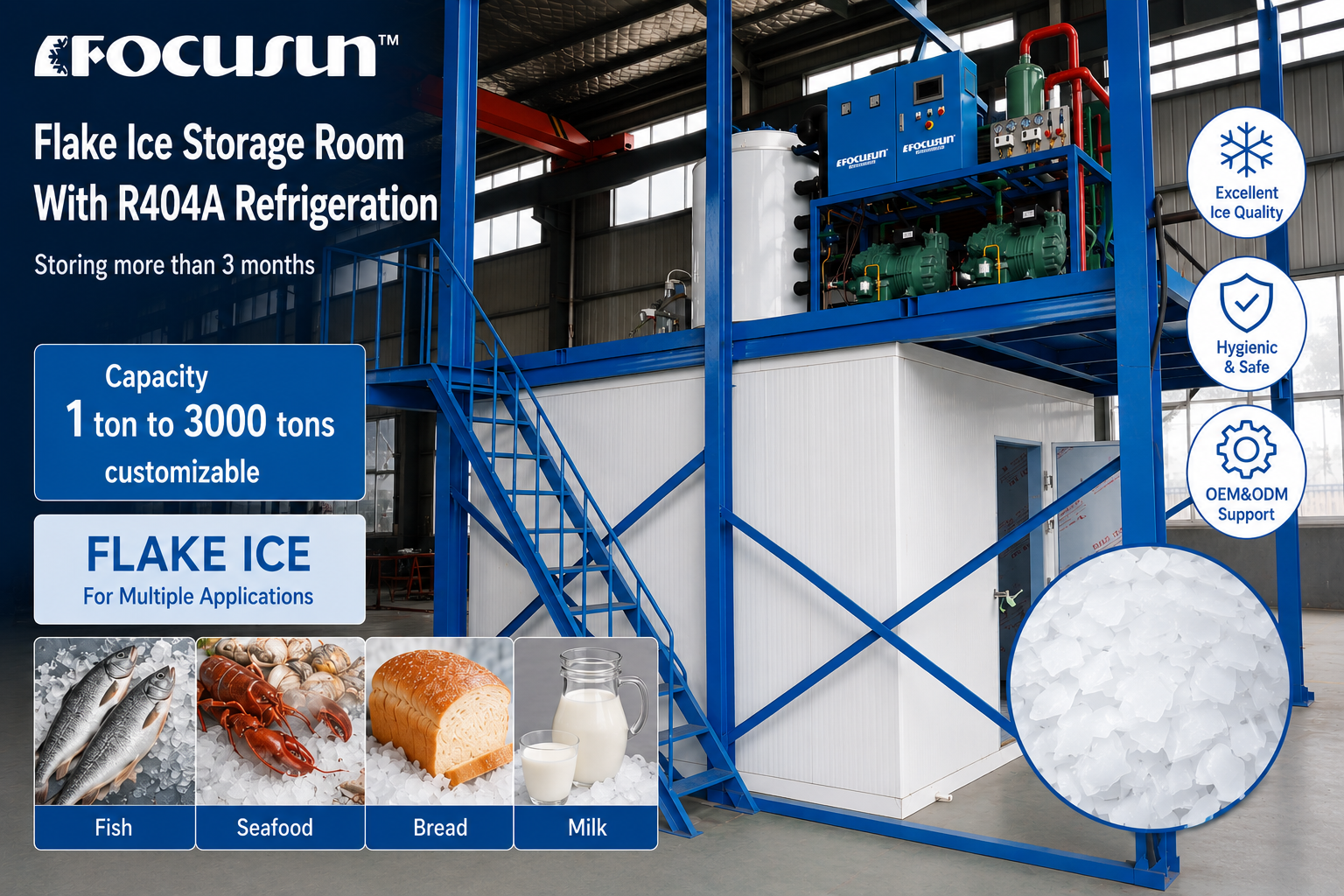
Every industrial system needs maintenance. Capacity planning should include service windows, cleaning time, and possible delays in raw water, power, or labor.
A machine can produce enough ice on paper and still fail the operation if the ice is hard to move.
This is common in growing businesses. At first, workers handle ice manually. Then production increases, the plant adds shifts, bags get heavier, loading becomes slower, and the ice room turns into a bottleneck. At that stage, the missing equipment is often not another ice maker. It is a better handling system.
Depending on your operation, you may need crushers, conveyors, ice hoppers, storage bins, automatic weighing, bagging systems, or palletizing workflow. For packaged ice businesses, Focusun’s automatic ice packing machine guide is relevant because packaging speed, bag weight accuracy, sanitation, and labor reduction can determine whether the production line actually works.
A good supplier should be able to discuss the full operating environment, not only quote a model number.
Explain what the ice touches, how long it must last, how it is transported, whether it is for direct food contact, and how workers will use it. The manufacturer should recommend an ice type based on the job.
Confirm power supply, water quality, drainage, ventilation, ambient temperature, floor loading, installation space, and service access. For outdoor, marine, or coastal sites, ask about corrosion-resistant materials.
Industrial ice systems should support stable operation, fault alarms, automatic protection, and clear control logic. Operators should not need to guess what is happening inside the system.
Food-grade systems need accessible cleaning points. Industrial systems need serviceable components. Ask how often the machine should be cleaned, which parts require inspection, and what spare parts should be kept on hand.
The route starts at water inlet and ends where the ice is used. Ask how ice will be harvested, stored, moved, crushed, packed, loaded, or delivered. This is where experienced project planning can prevent expensive redesign.
Focusun’s value is not only that it offers many ice machine categories. The stronger advantage is that the product range can be matched to different industrial routes: seafood preservation, food processing, commercial ice supply, concrete cooling, cold-chain logistics, and specialized cooling applications.
A buyer can start with the main Focusun ice machine collection, compare machine types, then narrow the decision based on ice format, daily output, installation conditions, and handling requirements.
For a small restaurant, a simple cube ice machine may be enough. For a fishing port, the right answer may be a brine system block ice machine with storage and crushing. For a seafood processor, it may be a sea water flake ice machine or slurry ice system. For an ice sales business, tube ice plus automatic packing may be the better trail.
The point is to match the machine to the route.
Before contacting an industrial refrigeration equipment manufacturer, prepare a short project brief. Include your product, industry, location, daily ice demand, peak demand, water source, power supply, site temperature, available space, preferred ice type, storage plan, and whether the ice will be sold, transported, packed, crushed, or used directly in processing.
That brief helps the manufacturer move from generic equipment recommendation to real project design.
The best industrial ice machine is not always the biggest machine, the cheapest machine, or the most automated machine. It is the machine that fits your operating terrain, keeps cooling reliable under pressure, and makes the daily work easier for the people who have to run it.
